The Science Core
  • Home
    • Internet
    • Market
    • Stock
  • Parent Category
    • Child Category 1
      • Sub Child Category 1
      • Sub Child Category 2
      • Sub Child Category 3
    • Child Category 2
    • Child Category 3
    • Child Category 4
  • Featured
  • Health
    • Childcare
    • Doctors
  • Home
  • About
    • naturescience
    • Physics
    • Chemistry
    • Astronomy
    • Engineering
  • Explore
    • Discoveries
    • Inventions
    • Technonogy
  • Contact
    • Email
    • Facebook
    • Linkin
    • Whatapp
  • Sponsor
Showing posts with label Astronomy. Show all posts

Tuesday, 26 January 2021

Black holes | Definition, formation, and facts

By Andrew Joseph     January 26, 2021     Astronomy, Physics, Sciencefacts     No comments   

Througout the field of cosmology, black holes has stood out to be among the most fascinating things ever studied about our universe.  The idea that a super massive and dense object exist in space where  gravity pulls so strong that it crushes and sucks anything across is path has continued to marvel astronomers and astrophysicists over the past years. Most famously, the winners for the 2020 noble prize award in the physics categories were all involved in various discoveries about  black holes.

So one may ask, what's really a black hole and how does it work?

Definition of a black hole

A black hole is a region in space where the force of gravity  pulls so strong that it prevent the escape of even the fastest of particles. Not even electromagnetic radiation such as light  can escape  it. 
A black hole's gravitational pull is so intense that no matter of any form can escape it once inside a certain region, called the event horizon.

So why are they called "black holes" anyway?

Ironically, black holes are not inherently black, neither are they conical spinning holes in the universe as some images may depict. The facts remains that the gravitational pull being experience on a black holes is so strong that it ends up crushing and sucking(like a hole), any matter found near it surrounding, including any rays of light.  When all light rays directed at a black hole are all sucked up to the last photon, what will be left is total darkness at the center. That is why black holes are often depicted as black looking monster tonadoes in space. 

So a clear answer to why black holes are so named is simply because:

"on a black hole, gravity pulls so extreme that it ends up sucking(like a hole) any matter found near it territory, including any traces of light rays, making it appear as black at the center"
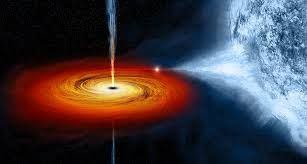
Image depicting a star being pulled by a black hole's instense gravity

So what makes a black hole's gravity pulls so strong?
Being called a "hole" doesn't mean  it's an empty space. It in fact a huge volume of matter squeezed and packed into a very small radius. A perfect analogy taken from the NASA website says it will be like squeezing a star ten times more massive than the sun into a sphere approximately the size of New York City. The result would turn out to produce an extremely dense structure in space, one in which it mass will cause an infinite curvature in space-time and it gravity, so strong that no matter can escape it immerse pull.
When the statement "sucks any matter found near in vicinity" is often made anywhere when talking about black holes, that shouldn't make one try to visualize black holes as cosmic vacuum cleaners that swallow up any matter close to it.  Although it seems quite easier to try to view from this perspective, but the truth remains that, black holes doesn't actually swallow matters to itself (as would vacuum cleaners), their gravity just smear and pulls objects towards it center. These objects in turn, due to being acted upon by series of chaotic forces will be spewed out in some way. Thus, it will be more accurate to think of a giant tonadoe when thinking of a black hole, but this time with a drawing force caused by gravity, not by rotating wind.

The event horizon

The center(or the core) of a black hole is where the extreme gravitational pull takes place, and this region is associated with an event horizon. On a black hole, an event horizon is the boundary where the speed needed to escape a black hole's extreme gravitational pull will exceed the speed of light. That means that an object needs to travel faster than light to escape a black hole's event horizon.
But according to Einstein's special theory relativity, nothing can travel faster through space than the speed of light. This means a black hole's event horizon is essentially the point from which absolutely nothing can 
return. 

Formation of black holes

The idea behind the formation of black holes were first predicted by Einstein's field equations for the general theory of relativity. The prediction was that if an object is sufficiently massive or dense,(like a neutron star) there will become a point that it will collapse in upon itself and then become even more denser  that it creates an infinite distortion in space-time, resulting in an object with a very strong gravitational influence on nearby objects. The object having such property were later termed as a black hole.

In accordance to that, it was thus observed that when a neutron star(a very dense, heavy type of star) finally becomes too massive and its gravity becomes too much to handle, the star collapses on itself and explodes leaving behind a black hole. 

Black holes were never seen or observed by scientists with ordinary space telescopes that were used to detect light and other space radiations.  Even after years of studying, research, argument, etc. It continued to remain a hypothetical prediction.

 Astronomers and astrophysicists however we're only able to deduce the presence of a black hole on space by detecting it gravitational effect on nearby stars and objects. For example, when a star or other interstellar objects crosses a black hole, they will be teared apart and drawn inward  Not long after the invention of the event horizon telescope that astronomers were now able to  photograph the first image of a black hole.


Image showing the first actual photo of a black hole and it shadow, taken by the event horizon telescope at the center of galaxy M87.

Historical prediction of black holes

In 1915,  Einstein published his general theory of relativity in which he showed that gravity is not an attractive  force existing between two masses as Newton said, but gravity is a function of space-time curvature. He included series of equations along with his theories to justify his claims. These equations are popularly known as "Einstein's field equations"(EFE). These equations related how the geometry of space-time affected other parameters like mass, energy, momentum, and stress. In short terms, the equations summaries the relationship between matter and the geometry of space-time. Due to the non-linear nature of Einstein's equations, Einstein himself assume that they were unsolvable. Lots of effort were made by other mathematicians and physicists in solving the field equations and understanding it solutions.

Not long after, in January 1916 Karl Schwarzschild a German physicist and astronomer produced the first exact solution to the field equations. He used Einstein's field equations to calculate the outcome of the gravitational effect of a single spherical body, such as a star.

The first case was that : If a mass of a star is neither very large or highly concentrated(made to be very dense), the gravitational influence of the star on other nearby matter will just be the same as that given by Newton's theory of gravity. That is to say that the gravitational force of attraction of the star will be given by F=GMm/R². Thus, Newton's theory was not incorrect, rather it justifies general relativity under certain conditions.

For a weak gravitational field, the result of general relativity does not differ significantly from Newton laws of gravitation. But for intense gravitational field, (i.e one cause by a large or extremely dense mass generating instense curvature in space time) the result diverge, and general relativity has been proven to predict the correct result.

The second case was the most important one, as it predicted an extraordinary object in space. The second case was that : If a body of mass were concentrated or confined within a vanishingly small volume, the resulting calculation shows that there will come to occur a point of infinite curvature and density - a singularity- in at the center, where gravity will become so strong that nothing pulled into the surrounding region can ever leave. Even light cannot escape.

Yes, black holes were first predicted by Einstein's general law of relativity. But as technologies advanced, we were able to observe our first actual black hole back in 2016.  It was thus proving Einstein's prediction to be correct.  
Read More
  • Share: 
  •  Facebook
  •  Twitter
  •  Stumble
  •  Digg

Monday, 25 January 2021

The 4 fundamental forces of nature

By Andrew Joseph     January 25, 2021     Astronomy, Physics     No comments   

 A force by definition is a push or pull that an object exerts on another, causing it to experience motion or deformity. Everything in the universe experience some kind of force that react with it in every second. These forces can be grouped in four major fundamental units and termed as "the four fundamental forces of nature".

The four fundamental forces of nature are the most major forces that govern the behavior of everything in the universe and they cannot be further divided into any other basic forces. They can also be termed as the fundamental interactions. The are the simplest unit of force in which other forces present in the universe are built on.

These forces include:

  • Gravitational force
  • Electromagnetic force
  • Weak nuclear force
  • Strong nuclear force
These forces can be either short range or long range, depending on the number of bodies they act on. Each of these forces will be briefly explained in this post.

Gravity


In the elementary stage, gravity was defined as the force that tends to pull all object towards the center of the earth. But the earth is not the only system that has or experience the influence of gravity, in theory, everything in the universe having mass will experience gravity.

Gravity is thus a force that that attract two or more objects having mass together. Gravity surrounds us, it responsible for pulling all objects having mass towards earth's center example when you throw a ball  into the air, it returns to you because of the earth's gravity. The earth is surrounded by a gravitational field and this force of gravity on the ball is what pulls it back to the earth.

Gravity is also what binds planets in an orbit around the sun. Gravity by nature is too weak to be noticed unless at least one of the masses is very large. As described by Einstein's general law of relativity, gravity comes as a result of space-time curvature. If an objects has more mass, it will create more curve in space-time and consequently will have more gravity. That is exactly why the gravitational attraction between planet's orbital around the sun appears to be stronger because the sun has a relatively greater mass, creating more space-time curvature(as Einstein explained) and thus more attractive force.

Newton was the first scientist that discovered the force of gravity while watching a falling apple from a tree and asked why the apple fell. He later postulated his laws universal gravitational law, stating that the force of attraction between two bodies of mass m1 and m2 is inversely proportional to the square of their distance R between their centers and is directly proportional to the product of their mass.

This can be represented mathematically as:

F= Gm1m2/R^2

Where 

G= the universal gravitational constant

m1 & m2 = the masses of the two bodies

R = the distance between them

From this equation, we can calculate the gravitational force of the earth to be equals to 9.807m/s^2.

Overview of gravitational force

- It are the weakest among  the four fundamental forces, having an infinite strength of 1.

-It always tend to attract objects, it never repels them.

- It cannot be modified, absorbed or shielded against.

- It has an infinite range, thus it capable of holding planets, stars and galaxies

- It hypothetically uses gravitons as the mediators

- Mass acts as the main source. 

Electromagnetism

The word "electromagnetism" contains two terms, namely electricity and magnetism. It was long thought that electricity and magnetism  were separate forces, ideas changed as Einstein's law of relativity describes electricity and magnetism not as separated forces, but as inter-related phenomena. Electricity gives rise to magnetism and vise-versa. 

Electromagnetic force is a force that acts between electrically charged particles (electrons, protons, ions, photons) and it's so named as it exhibit  both the property of electricity and magnetism. 

It is the force that causes like charges to repel each other and unlike charges to attract each other. These phenomenon of attraction and repulsion is what binds electrons close to their orbitals, as they are attracted to the positively charged neutrons in the neucleus.

Light also is an electromagnetic wave, that undergoes continuous oscillation from electric field to magnetic field at right angle to each other.

Electromagnetic induction is also a phenomenon of electromagnetism, where electricity can be generated using  changing magnetic field across a coil of conductor.

So as we can see, electromagnetic force plays a vital role in our day to day living.

Overview of electromagnetic force

-  It is the force that acts upon charged particles, and it  contains both electrical and magnetic properties.

- It is the second strongest fundamental force of  nature, having an infinite strength of 10^36

- The also posses an infinite range.

- Photons acts as their mediator
- They travel at the speed of light(300 000 km/s)

Weak nuclear force

The weak nuclear force or weak interaction is the force responsible for nuclear changes in the sub-atomic particles, these changes includes; nuclear fusion (which is the combination of atomic nucei), nuclear fission(which is the disintegration of atomic nucleus), beta decay( process of converting neutrons to protons and vise-versa) , and electron capture. 

These nuclear changes are very vital for the working of the universe and even life on earth. For example, nuclear fusion is responsible for generating energy from the sun and other stars, where hydrogen is converted into helium.

Overview of the weak nuclear forces

- It is responsible for nuclear changes in sub-atomic particles

- It is the third strongest fundamental forces of nature having an infinite strength of 10^25

- They occur at a very short range as it only acts upon sub-atomic particles. Hence, it has a infinite range of 10^-18

- W and Z bosons acts as the mediator

Strong nuclear force

The strong nuclear force is by far the most strongest and complex force in the universe. It only act upon sub-atomic particles in the nucleus. The atomic nucleus is made up of protons and neutrons, the protons possesses a positive charge while the neutrons are electrically neutral. The protons which were supposed to repel each other because of their like charges are tightly binded together in the nucleus by the action of a force called the strong nuclear force.

The electromagnetic force couldn't possibly keep the nucleus of an atom together, because it is much too weak, and the protons would simply repel one another and fly, because they are all positively charged, and we know that two positively charged particles won't attract each other. So there needs to be a stronger force, and that just happens to be the Strong Force. This force is also responsible for binding Quarks and Gluons into Protons and Neutrons.

Read More
  • Share: 
  •  Facebook
  •  Twitter
  •  Stumble
  •  Digg

Friday, 6 November 2020

10 wonderful facts about rainbows

By Andrew Joseph     November 06, 2020     Astronomy, Naturescience     No comments   

Rainbows are also one of the most beautiful and amazing natural phenomena in our atmosphere. It normally occurs as a brilliant spectrum of light in the sky in shape of an arc and sometimes seen immediately after rainfall.The formation of rainbows is thus manned by complex geometry and optics relating to the reflection, refraction and dispersion of sunlight between air and water droplet. You definitely have to study a lot of things relating to general relativity, waves and optical physics in other to fully understand the formation of rainbows, that is why this post is not about the formation of rainbows but on wonderful fact you should know about rainbows.

What are rainbows?

Simply puts, rainbows are natural showcase of light spectrum in the sky caused by the reflection, refraction, and dispersion of sunlight between air and water droplet.

10 Wonderful facts you should know about rainbows


1. Rainbows are one among many other amazing natural sight in our earth's sky, including auroras, steves and the glory phenomena.

2. Rainbows are produced when sunlight passes through droplets of water,  thats why it normally occurs immediately after rainfall. So both sunlight and droplets of water should strike each other at the right time and an observer must be position at the right geometric angle to see it. That is to say that an observer cannot see a rainbow at any angle. He/she must be stationed behind the sunlight, while the rainbow appears opposite the sunlight.

3. We have up to 12 types of rainbows which have their different methods of formation. These includes: Twinned rainbow, multiple rainbow, full-cycle rainbow, monochrome rainbow, fogbow, supernumerary rainbow, rainbow under moonlight, reflected/reflection rainbow, high order rainbows.

4. Have you ever thought of being in the exact location where a rainbow is produced so as to touch it or have a closer sight? The fact is that a rainbow is not like an object or a thing that exist physically, it's a mere optical illusion that is caused by a geometric connection between sunlight and water droplets and an observer just appears to be in the right place and positioned at the right angle to see it. Thus one cannot physically approach a rainbow. Even if you seem to see it physically close to a house or a tree, another observer standing at that location will also seem to see it farther away from itself at the same distance and angle as you saw it.

5.  The shape of a rainbow is actually a full cycle not an arc (as it sometimes appears to people), but when viewing from the ground level, an observer only happen to see half of the rainbow which is formed due to the water droplets illuminated above the ground level. But even so, it possible to see a complete circle of a rainbow when viewing from an airplane which is above the ground level.

6. The colour spectrum appearing in a rainbow comes as a result of the separation of sunlight into it component wavelength. This is similar to the spectrum obtained when pointing a light source to a glass prism, we will notice that the light will separate into it component wavelength on the other side. In the case of rainbows, water droplets serves as earth's prism, separating the light waves coming from the sun into it component wavelength. 

7. A rainbow has 7 colours, and these colours include Red, Orange,yellow, green, blue, indigo, violet. 

8. Isaac newton was the first scientist that distinguish the visible colours present in a spectrum. He divided them into 7 colours which were exactly the number of colours visible to humans on a rainbow. That is to say that although the number of colours appearing on a rainbow seems to be 7, there are also much more invisible colours present in a light spectrum, but who cares, as Robert noted, color is simply a perception created by the human visual system, and as such it has no real physical meaning whatsoever.

9. In some cases, while watching a rainbow one can see another fainter form of rainbow appearing above the original one. This is called a secondary rainbow and this occur due to a double reflection inside of the water droplet. Due to angle factor, the colour order of a secondary rainbow is always in reverse with respect to the original rainbow.

10. An artificial rainbow can be made using a water sprinkler, you must be standing behind the sun while sprinkling the water high above the ground and in a very clear sky.


Read More
  • Share: 
  •  Facebook
  •  Twitter
  •  Stumble
  •  Digg

Friday, 30 October 2020

Different types of galaxies

By Andrew Joseph     October 30, 2020     Astronomy     No comments   


The most widely used classification scheme for galaxies is based on one devised by Edwin P. Hubble and further refined by astronomer Gerard de Vaucouleurs. It uses the three main types, and then further breaks them down by specific characteristics (openness of spirals, size and extent of bars, size of galactic bulges). In this age of multi-wavelength observing, the sub-classifications also include markers for such characteristics as a galaxy’s star-formation rate and age spectrum of its stars.

Read More
  • Share: 
  •  Facebook
  •  Twitter
  •  Stumble
  •  Digg

Thursday, 24 September 2020

What causes Auroras?

By Andrew Joseph     September 24, 2020     Astronomy, Naturescience     No comments   


        Apart from rainbows, halos, eclipses etc. An aurora is also an example of a natural light-color showcase in our atmosphere. But what really makes this happen and how does it appear to be so beautiful?Let find out.
It all because of a simple interaction between the sun and our atmosphere.

       An aurora or polar light is a natural showcase of light and colors in our earth's sky. There are two types of aurora; If you are near the northern pole, it is called aurora borealis, if you are near the southern pole, it is called aurora australis. It nothing but simply occurs as a result of our earth trying to protect us from excessive radiations from the sun. But how?  Let break it down further.


The Earth's magnetic fields

     The sun sends us a lot more than just heat and light; It also sends lots of energy and different kinds of particles our way. The outer space generally is a very dangerous place where lethal radiation is very common, even so, meteoroids, asteroids and many other flying bodies are always in random motion thus, our earth needs to be shielded from the danger of these galactic substance penetrating and destroying our home. 

Luckily, our earth is indeed protected by an invisible force we call "magnetic field". But the question is; How does earth generate such a strong magnetic field and what role does it play in shielding us ?  Let explain.

     The center of our earth is accommodated by a spinning ball of molten Iron called the CORE. The action of this core causes our planet to generate a large and powerful magnetic field which stretches far into space. This magnetic field protects us from harmful radiation and high energy particles emanating from the sun by neutralizing these particles. The region associated by this magnetic field is called the magnetosphere. Let take a look at an example of these dangerous radiations.


Solar flares:  An example of these high energy particles are the solar flares.  Solar flares are  brief sudden eruption of high energy hydrogen gas from the surface of the sun. It can generate energy as much as billions of hydrogen bombs; and explosions in the outer region(or corona) of the sun, which blast billions of tons of matter into space.

         When dangerous solar waves, such as solar flares, solar winds, and solar storms from the sun is radiated to the earth, it will not penetrate into the earth because the earth is protected by a magnetic field, so instead, the solar particles which are mainly composed of electrons and protons will travel down the magnetic field lines, at the north and south poles into the earth's atmosphere. Since our earth's atmosphere is composed of gases, what we call ionization will take place between the particles and the atmospheric constituent, and the end point is that it will emit light of various colors and spectrum. These light are called aurora. Oxygen will give off green and red light. Nitrogen glows blue and purple. Unlike rainbows, auroras are not optical phenomena and  even though they can only be seen during nightfall, they are actually caused by the sun. They also do not only occur in planet earth. It is also likely to occur in planets that also have magnetic fields and atmospheres.
        Another kind of celestial phenomenon is STEVE( Strong Thermal Emission Velocity Enhancement). Although scientist know little about this kind of earth's wonder, it as confirmed that it's certainly not an aurora. Look at the picture below, you probably may have had a glimpse in some tv shows like discover family or so. It always appear as a purple and green ribbon in the sky. Very soon, more research might reveal more about this aurora-like phenomenon, but in the mean time, study has it that it more likely to be related to the ionosphere and current technology developed will help scientist investigate further on the nature of charged particles in the ionosphere.


Hope you enjoyed the post, and are really enlightened on matters relating to the planet we live in. If you have any question, just include it in the comment box below, I will be glad to respond. Subscribe for more post concerning physics and astronomy.
Read More
  • Share: 
  •  Facebook
  •  Twitter
  •  Stumble
  •  Digg

Tuesday, 22 September 2020

What is the difference between a meteor and a comet

By Andrew Joseph     September 22, 2020     Astronomy, Naturescience     3 comments   

Have you ever seen a fast moving streak of light in the sky? Some call it meteorite, some call it comet, some call it meteor and still some assume it's a rocket. Read this if you are really curious to know about amazing natural sight in our planet. 

Among all the interplanetary bodies visible to humans, stands out these two beautiful fast moving streaks of light, called meteors and comets.  But due to their physical similarities, humans sometimes can't tell their difference, and due to this, they sometimes mistake one for another. So in today's post, we are going to highlight the differences between a meteor and a comet, these will include what they are made up of,  how they are formed, and where they are formed in the outer space? But first, what is a meteor?

WHAT IS A METEOR?


In a layman's term, a meteor is a small particle of matter (usually a meteoroid) from outer space that finds it way in the earth's atmosphere. 
A meteor usually get ignited in the process due to the collision between itself and the atoms in the earths atmosphere that is why it always appear as an incandescent streak of light.

How are meteors formed?


When asteroids or other rocky space element collide (smash into each other) and shatter into smaller pieces, those debris are called METEOROID and they have not yet  find it place to the earth atmosphere. Some meteoroids are always forced out of their regular orbit and at high velocity due to the shock wave caused by the collision and it is still flying at high speed in the outer space. It is important to note that a meteoroid is not yet ignited because there is no presence of oxygen in the outer space, so it does not support  burning. 

As the smaller debris are moving randomly at different direction and with high speed, if any of it finds it way to the earth atmosphere, it will thereby exhibit different properties. What will happen is that the walls or outer shells of it atoms will collide with the outer shells of the atoms of the atmosphere, and thereby causes friction. So since there is the present of oxygen in the earth's atmosphere(you guess it right) it will ignite and cause that streak of light you normally see there burning. So because of these different properties, it is called a METEOR.
 Still, not all meteors usually find their way to the earth's surface, In fact 60% of meteors will completely burn off in the sky before reaching the earth surface. So some meteors that luckily survive a trip to the earth surface are termed as METEORITE. So we can see the aspect of science, how the same material can be given multiple names at different stages because of the properties they exhibit.

What are meteors made of?


Since meteors are from meteoroid, the question should be; what are meteoroids made of? but the aspect of chemistry has change the whole game during when a meteoroid enters the earth atmosphere.
Generally, meteoroids are made mainly of metallic element like nickel, Iron, Magnesium and even calcium. And also some non-metals like silicon and sodium. But as a meteoroid enters the earth's atmosphere, it molecules will break down into particles due to the high speed collision between itself and air and they will also recombine between themselves (both the molecules of air and that of the meteoroid). In that process, some other element such as nitrogen, oxygen and other rare atmospheric gases will be emitted.


The colors of the meteors also has something to say about their chemical composition (reference the image above).  The speed at which the meteor enters the Earth’s atmosphere can also affect the colors they exhibit. The faster a meteor moves, the more intense the color may appear, according to the American Meteorological Society (AMS). Meteoroids are formed in a region further closer to the sun.

WHAT ARE COMETS?

Comets are frozen and icy galactic bodies which when orbiting close to the sun, vaporizes and begin releasing gases and dust into it surrounding in a process called outgassing. Comet have a icy center called "the neucleus" or core and it surrounded by a large cloud of gases and dust called the COMA. 
The process of outgassing is due to the icy core getting warm as a result of receiving solar radiation and then it vapourizes and produces the surrounding coma. The preence of the coma which is very observable is what distinguishes the comet from other celestial moving object, like the asteroid and meteoroids. 


What are comets made up of?

Comets are divided into 2 major parts, which are the Neucleus(or core) and the coma and each of them are composed of different states of matter.
  1. The Neucleus : This is the center or core of the comet. They are composed of mainly ice, rocks and frozen gases such as carbon dioxide, methane and ammonia.
  2. The Coma : When the neucleus is expose to solar radiation and solar wind, it get warm and then spew into a large stream of dust and gases forming a cloud like  atmosphere around the neucleus called COMA. So water and much more gaseous compounds and element accommodate the coma.  
The pressure exerted by the solar radiation on the comet causes it to streamline and form a long pointed tail, divided into the gas tail and dust tail.

It is also important to note here that unlike the meteor, the comet is not self illuminated, both the core and the coma are illuminated by the sun. Like are earths satelite (the moon), the comet is illuminated by reflection and only becomes more visible to humans in the night.


Meteors Comets
Mainly made up of rocks and metals Mainly made up of ice and dust
Existed from debris of asteroids and other planet Existed billions of years ago when the solar system was formed
Formed closer to the sun Formed further away from the sun
Smaller in size Very large in size
Are self illuminated Are not self illuminated, they depend on reflection from the sun
Read More
  • Share: 
  •  Facebook
  •  Twitter
  •  Stumble
  •  Digg
Older Posts Home
View mobile version

General categories

  • Astronomy (6)
  • Chemistry (17)
  • Electronics (5)
  • Geography (1)
  • How stuffs work (8)
  • Naturescience (14)
  • Physics (17)
  • projects (3)
  • Sciencefacts (11)
  • wildlife (5)

Popular Posts

  • Emulsion - definition, properties, and examples
  • Suspension - meaning and examples
  • What is a Tyndall effect
  • Metal ores - Meaning and examples
  • Concept of electrovalent(ionic) bonding
  • What is the difference between a meteor and a comet
  • covalent bond - definition, properties and examples
  • Top 10 hardest natural substances on earth
  • Why do birds and squirrels not get shocked by the high voltage power lines
  • Black holes | Definition, formation, and facts

Sub categories

Physics

  • Heat
  • Electricity
  • Magnetism
  • Motion
  • Forces of nature
  • AC circuit
  • Optics
  • Waves
  • Electromagnetism

Chemistry

  • Acids, bases and salts
  • Chemical polarity
  • SOlutions and solubility
  • Chemical bonding
  • petrochemicals
  • Industrial chemistry
  • Natural effects
  • Electrolysis

Nature science

  • Optical illusions
  • Auroras
  • celestial bodies
  • Natural forces
  • Organisms
  • Ecosystem

Electronics

  • Power Electronics - Introduction
  • Types of PSU
  • LPS
  • Oscilator circuits
  • Smps
  • Filters
  • Digitial circuits

Featured post

Top 10 world's fastest fishes

The Science Core

The science core is a leading online platform aiming at delivering the best collection of sciencific, technical, and medical research and discoveries in the world straight to you.

Follow us on social media

Quick navigate

  • Chemistry
  • Physics
  • Astronomy
  • Sciencefacts
  • Home
  • About us
  • Contact
  • Editorial Guidelines

Copyright © The Science Core | Powered by Blogger
Design by Andrew Joseph